

Nine returning players. Sixty-eight new ones: that was Colorado’s roster in 2023, and it wasn’t really a roster so much as a bet Deion Sanders made in public, on national television, with his own last name attached to it. People called it a gimmick at the time. A few called it the future. Almost nobody called it normal, which is the funny part, because normal is exactly what it turned into.
Not because Sanders was right, necessarily, but because the question underneath what he did stopped being optional for anyone else. Rosters can turn over almost completely in a single offseason now. The money that would stop that from happening is capped, sometimes hard, sometimes softer than it looks. So every program in the country is stuck answering some version of the same question every year: keep what you’ve got, or go get something new?
The Evidence
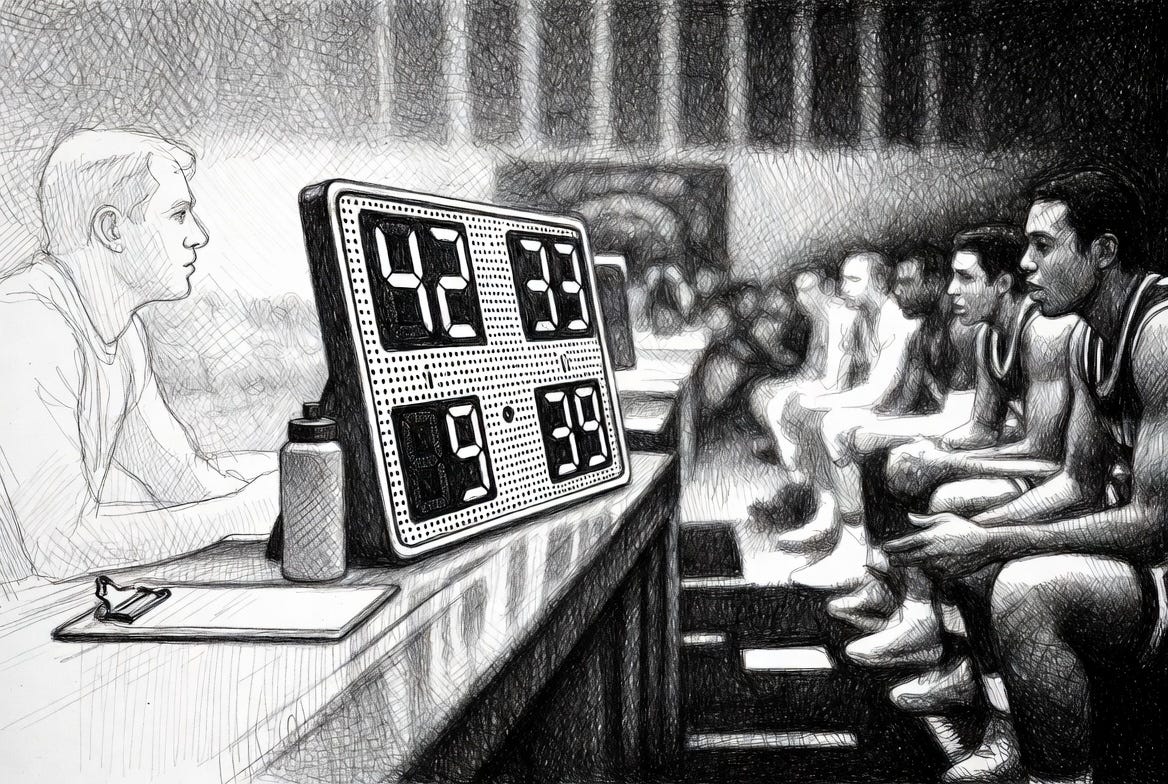
Basketball is a good place to see that decision play out, mostly because the shift there is almost hard to believe if you haven’t been paying close attention. Last season, for the first time since anyone started counting, less than half of all Division I minutes went to guys who’d been on the roster the year before. Six high-major programs didn’t return a single minute: not “not much,” zero, a team that existed in November that had, in any meaningful sense, nothing to do with the team from the March before.
Here’s the twist, and it’s a real one. None of this seems to be working, at least not the way people assumed it would.
Kentucky is the best evidence, and it spans two different eras, which makes it more convincing rather than less. Go back to 2020-21, years before any of this NIL money existed. John Calipari had the No. 1 recruiting class in the country, by consensus, no argument. Kentucky went 9-16, missed the tournament entirely, the worst season the program had had in over a hundred years. Then, in 2024: different roster, same shape of problem. Reed Sheppard, Rob Dillingham, a loaded freshman class again, and Kentucky lost in the first round to 14-seed Oakland. Two different money environments, same result. A pile of talented new pieces isn’t a team just because you called it one.
Kansas is the flip side of that coin, and it’s arguably a cleaner story. Bill Self won the whole thing in 2022 with a roster that was mostly homegrown, patched with a few veteran transfers like Remy Martin who fit in around guys Self had coached for years. Since then, Kansas has gone deeper into the portal, and the results have gone the wrong direction: no trip past the second weekend since that title, a first-round-ish exit two years ago that hadn’t happened at Kansas in twenty years, big-name transfers like AJ Storr and Rylan Griffen who were productive elsewhere and then weren’t at Kansas. Self basically has the receipts sitting in his own program’s history, and the program hasn’t been listening to them lately.
It’s not just anecdotal, either. Teams that kept three-quarters or more of their minutes made the tournament twelve times out of fifteen tries over a recent four-year stretch, two of them reaching the title game. Teams that kept under sixteen percent made it six times out of twenty. And the 2025 Final Four made the point plainly: three of the four teams standing were continuity teams. Houston at 82 percent returning minutes. Florida at 70. Auburn just under. Turnover might be the fashion right now. It isn’t the thing that’s actually winning.

The Money
The build-or-buy decision doesn’t stop at basketball’s edge. It’s the same choice every athletic department is making across every sport it sponsors, because the money all comes from the same place. The House settlement caps what a school can pay athletes directly at something like twenty million a year, and that cap covers the whole department, not one sport in isolation. Football, basketball, baseball, track, it’s all drawn from the same pool, and someone has to decide how to divide it. Most schools send the largest share, something like fifteen million of the twenty, to football, leaving three million or so for basketball and whatever’s left for everything else. Different program, different bet, same underlying question the basketball examples above were already answering.
That scale gives the football portal its particular intensity. A veteran starting quarterback can pull three to five million dollars now. Offensive tackles and defensive ends who can actually play are getting seven figures without much of a fight. And because there’s no spring portal window anymore to patch a hole later in the year, the logic coaches use is blunt: pay for the guy now, or watch him leave and deal with the hole in August.
Some programs went out and bought a lot, but it’s worth asking why before drawing any conclusions from it. Oklahoma State brought in forty-nine transfers in one cycle, and West Virginia and Purdue weren’t far behind. All three had just been through the wringer: Oklahoma State went 3-9 the year before, and West Virginia and Purdue both made coaching changes tied to bad seasons of their own. None of them were choosing volume as some bold new philosophy. They were doing triage, using the portal to rebuild fast because the alternative was several years of losing while a new staff recruited high schoolers the slow way.
That’s a genuinely different situation than Georgia, Clemson, Notre Dame, and Texas A&M, who held onto their rosters at a rate well above the rest of the sport during that same stretch. Those programs weren’t rebuilding anything. They were already good, already in the playoff conversation, and had far less reason to blow anything up. So the real comparison isn’t retention versus volume as two equally available strategies. It’s closer to this: programs already near the top tend to protect what they have, and programs digging out of a hole use the portal as a shortcut, because it’s faster than waiting on high school recruits to develop. Whether that shortcut works long-term is still an open question nobody can answer yet, since most of these rebuilds are only a year or two old.
Baseball Already Did This
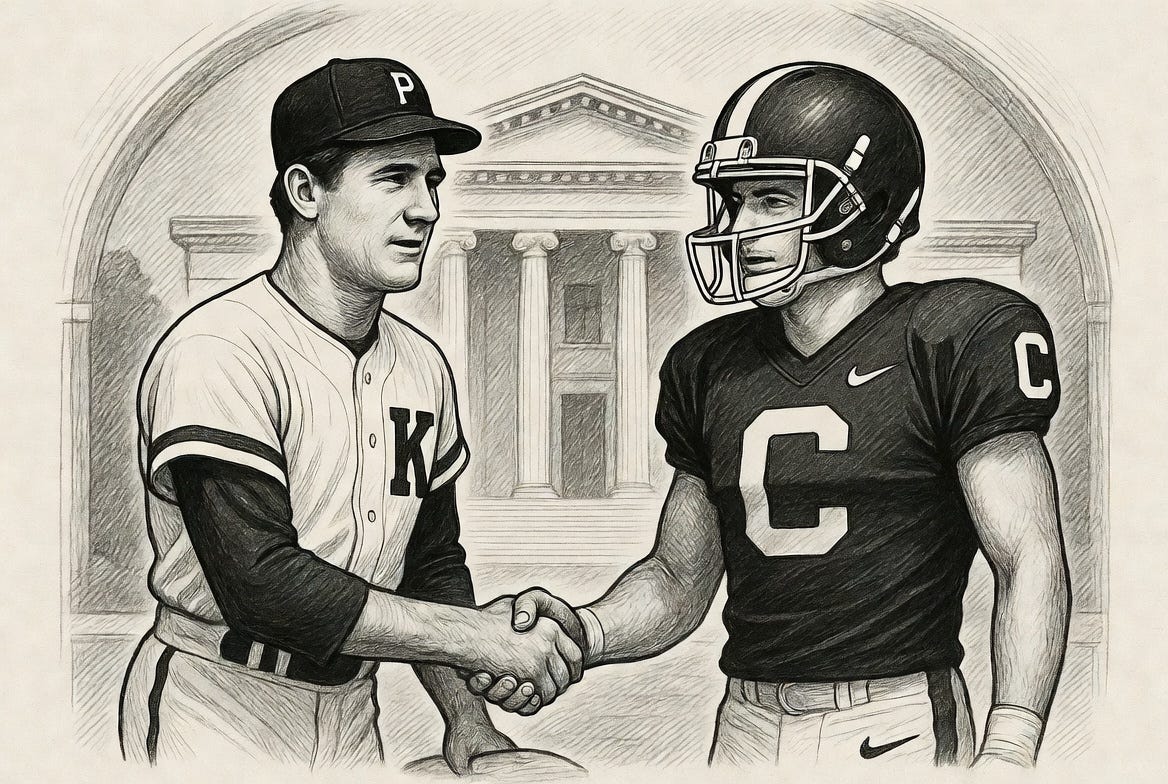
Here’s the thing that gets lost in all of this: none of it is actually new. Go back to December 1975. An arbitrator named Peter Seitz ruled that two pitchers, Andy Messersmith and Dave McNally, could sign wherever they wanted after playing a season without a contract. Baseball had run for nearly a century on a reserve clause that basically owned a player for life. One ruling, and that was over.
Front offices panicked, more or less, in both directions. Some teams threw money at any recognizable name, treating free agency like a shortcut around the slow work of actually developing players. Others froze, scared of long contracts for guys they hadn’t grown themselves, and watched talent walk right past them instead. It took most of a decade to land somewhere sane in between: develop your own core, use the open market for specific gaps, don’t confuse activity with strategy. A few teams never fully made that turn even now, fifty years later. The Rays have carried one of the smallest payrolls in the sport for two straight decades, bottom five almost every year, and they’ve still made the playoffs regularly, almost entirely off drafting and developing rather than buying.
The NFL went through its own version once free agency arrived alongside a salary cap in the early nineties, just slower. Teams that grabbed every marquee free agent in those first few seasons often ended up bloated and stuck, no cap room left to fix a mistake once they’d made it. The franchises that stuck around drafted well, developed what they drafted, and used free agency the way you’d use a good spice rather than the whole meal.
College sports actually has something neither baseball nor football had back then: a preview. Every athletic director making these calls right now has fifty years of baseball history and thirty-some years of NFL cap history sitting there, fully documented, showing exactly what worked and what blew up in someone’s face. Some programs seem to be studying that. A lot of others are acting like nobody’s ever lived through this before, which, at this point, just isn’t true anymore.
The programs that crack this first won’t be the ones who spent the most money. They’ll be the ones who figured out, faster than the rest of the league, which guys were worth the patience, which spots were worth just going out and buying, and which situation, rebuilding or already-elite, they actually were in before picking a strategy built for someone else’s problem. Baseball eventually learned that, unevenly, some franchises more than others. Football learned a version of it too. College sports is out there learning it right now, in real time, in front of everybody.
The Deeper Dive
On paper, schools without a football program should have a real edge in basketball. They’re working under the same twenty million dollar cap as every other school, since that number applies flatly across Division I, not based on what any individual school brings in. But the cap only sets a ceiling. It doesn’t hand anyone the money to reach it, and that’s where the real limitation shows up. A school that never fielded football never built the television deals, ticket sales, and sponsorship money that come with one, so even with no football bill to pay, there’s often not enough revenue to get anywhere near the cap either.
Gonzaga is the clearest example. Its entire athletic department, every sport combined, brings in somewhere around $48 million a year. That’s the whole operation, not a spare pool sitting around for one sport. The school’s own athletic director has said flatly that Gonzaga won’t come close to the $20.5 million cap, and he’s declined to even estimate a basketball number, because there isn’t fifteen million dollars lying around to spend on it.
Big East schools tell a different story, and it’s the real version of the advantage people assume Gonzaga has. Without football’s costs but with a real revenue base behind them, mostly built through alumni giving and corporate sponsorship rather than television money, Big East programs are reportedly spending somewhere between five and seven million dollars on basketball, with total revenue-sharing figures at some schools estimated as high as seven to twelve million. That’s real money, genuinely more than the two to four million a typical football-first Power Four school can spare for basketball. It’s not the fifteen million dollar figure that got tossed around early on. Nobody is actually spending that. But it’s a meaningful gap, and it’s the clearest evidence that going without football can be a real basketball advantage, as long as the revenue is there to back it up.
For the Curious
John Helyar’s Lords of the Realm is still the best account out there of what the Messersmith-McNally ruling did to baseball’s ownership class, who fought free agency in court and in the papers for years before they finally caved. Fair warning: it reads like business history more than sports writing for long stretches, boardrooms and lawyers more than diamonds and dugouts. Helyar tells it from ownership’s side of the table mostly, so if you want the on-field version of that era, you’ll want something to pair with it.
Worth Watching
UCLA’s head basketball coach, Mick Cronin, keeps saying, publicly and often, that schools should be allowed to blow past the twenty million dollar cap specifically to keep their own guys, arguing that constant movement is bad for the athletes and worse for the sport. Whether that goes anywhere is genuinely worth tracking. If it does, a good chunk of this issue is out of date within a year.
Thanks for reading The Precedent. If you enjoyed this issue, share it with someone who would too.
Written by Bob Sloop