

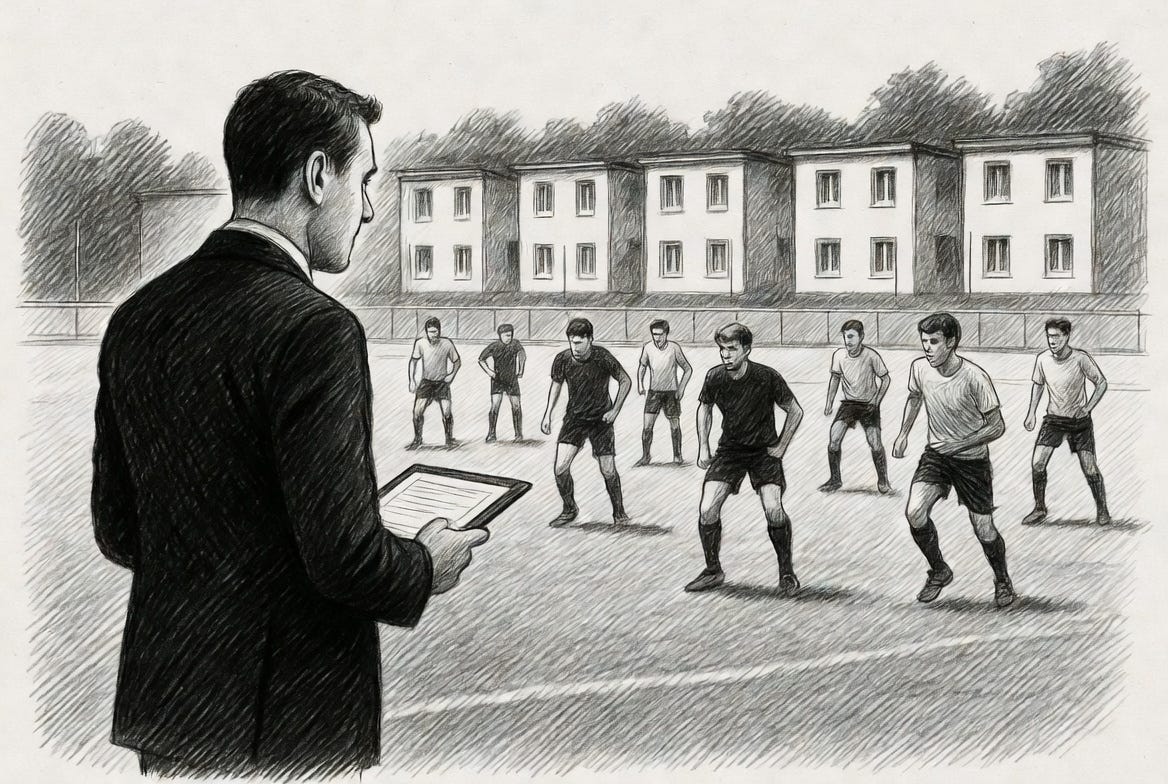
The USMNT’s 2026 World Cup ended in Seattle on July 6, a 4-1 Round of 16 loss to Belgium. It was the fourth straight tournament in which the Americans went out at that same general stage, echoing the exit in Qatar four years earlier. Christian Pulisic, the team’s most accomplished attacker, suffered a bone bruise and microfracture in his lower right leg in the second half and was subbed off, ending his tournament. The U.S. did win a knockout match this time, its first since 2002, but that distinction comes with an asterisk: the 48-team format added an entirely new round, the round of 32, that didn’t exist in the previous 32-team bracket, so the “knockout win” came against a fuller and more diluted field than past tournaments required. The run still ended short of the quarterfinals on home soil, with every scheduling and travel advantage a host nation could ask for.
So look at how a soccer career actually begins in the countries that keep reaching the later rounds.
In France, the answer starts at a converted estate outside Paris called Clairefontaine, opened by the national federation in 1988. Every year, about 22 boys are plucked from the Paris region at age 13 and moved in, training all week and going home only on weekends. Nobody’s family pays for it. The French Football Federation, a nonprofit recognized by the French state as serving the public interest, covers it and also distributes more than 100 million euros a year to amateur clubs across the country, subsidizing everything from coaching to bus fare. Thierry Henry slept in those dorms. So did Nicolas Anelka and, more recently, Kylian Mbappé.
The Netherlands does it differently but arrives at a similar place. Ajax isn’t run by a federation at all. It’s a private company, traded on the Amsterdam stock exchange, and its academy runs on ticket revenue, sponsor money, and the transfer fees it collects when a bigger European club buys one of its graduates. Boys enter around age 8 and spend a decade absorbing one tactical philosophy, so that by the time a 17-year-old gets promoted to the first team, he already speaks the same footballing language as everyone around him. Frenkie de Jong and Matthijs de Ligt both came up this way.
Brazil and Argentina run looser, less formal versions of the same idea, but the economics land the same place. Clubs like Santos, Boca Juniors, and River Plate start watching children as young as 6, sign the best of them to youth contracts that cost nothing, and push the most talented into first-team minutes by 17 or 18. Messi left Rosario for Barcelona’s academy at 13. Neymar came up through Santos, the same club that produced Pelé a generation earlier.
Three different ways of paying for it, France’s public money, the Netherlands’ private club revenue, South America’s informal investment, all land in the same place: the family never pays, and a genuine prospect is playing real minutes as a teenager.
The American version looks nothing like this. U.S. Soccer is a nonprofit too, but unlike its French counterpart, it takes no government money at all. Youth development here runs almost entirely through private clubs that bill families directly, and at the level where scouts are actually watching, ECNL, MLS Next, that bill can run well into five figures a year once travel and private training get added in. Most players who do make it through that system spend four more years in college before turning pro, often not signing a professional contract until they’re 21 or 22.
Christian Pulisic is the exception everyone points to, and his path is worth a closer look, because it doesn’t actually match the European model either. He came up through PA Classics, a pay-to-play club near Hershey, Pennsylvania, joining around age 10. His father, Mark Pulisic, a former professional indoor soccer player, directed the PA Classics academy itself from 2000 to 2015 and coached Christian directly for much of that stretch. So Pulisic’s development ran through the same pay-to-play system every other American prospect uses, just with his own father running the program. He didn’t leave for a real academy environment, Borussia Dortmund’s, until he was 16, three years after Messi had already moved into La Masia. Pulisic isn’t proof the American system can produce a Messi. He’s closer to proof that a gifted kid whose father happened to run the local academy can outrun a mediocre system by a few years, not escape it entirely.
Now set soccer’s price tag next to the other sports Americans grow up playing, because the comparison isn’t as clean as it first looks. Youth hockey, by some measures, is the single most expensive sport in the country. Its elite AAA tier can run $10,000 to $25,000 a year, rivaling or beating elite club soccer. Elite AAU basketball gets expensive too, once travel and tournaments enter the picture, though it varies wildly by program. Football sits at the other end almost entirely because its top level, the one recruiters actually watch, is high school football, and high school football is free. Basketball lives somewhere in the middle: high school still matters, but AAU has become close to mandatory for real exposure, and AAU isn’t free either.
Soccer, in other words, has more in common with hockey than with football on the cost question. Both sports funnel serious development through private clubs that bill families directly, and in both, the high school team isn’t where anyone with a scholarship or a pro contract in mind is spending their energy. Where the two sports really part ways is in who else is playing. Hockey’s serious international competition comes down to six countries, Canada, the U.S., Sweden, Finland, Czechia, Russia, drawing from broadly similar populations and resources. That’s a field the U.S. can and did win, beating Canada in overtime for Olympic gold in Milano-Cortina this year, its first hockey gold since 1980.
Soccer’s field isn’t six countries. FIFA counts 211 member federations, more than the United Nations has member states, and for most of them, soccer isn’t competing against three other major sports for the nation’s attention and talent. It’s the only game in town. Baseball splits the difference: its serious international field is maybe 15 to 20 countries, which is part of why the U.S. still produced about 74 percent of MLB’s Opening Day rosters this year even as Venezuela beat the Americans in the 2026 World Baseball Classic final, the second straight WBC final the U.S. has lost after winning the tournament outright in 2017.
There’s also a live, unsettled argument about whether America’s best all-around athletes even end up trying soccer in the first place. Some former U.S. national team players believe the money and visibility of football and basketball, Friday night lights, March Madness, the NIL paydays now available in college, pull the most gifted kids elsewhere before soccer gets a real look. Others push back hard on that idea, arguing that soccer rewards ball control and split-second decision-making in ways that don’t track with the size and speed that make someone a star in football or basketball, so the “our best athletes would dominate” theory doesn’t hold up under its own logic. Neither side has settled it.
What U.S. Soccer has actually done, measurably, is start closing the funding gap at the margins. MLS launched MLS Next in 2020 to build something closer to a centralized academy structure, stepping in after the U.S. Soccer Development Academy collapsed early in the pandemic. All 30 MLS academies, including Inter Miami, Atlanta United, and FC Dallas, are now free to attend for the prospects who make them, and the league added a second, broader Academy Division for the 2025-26 season that more than doubled the program’s total clubs and players. That’s the closest thing the American system has to Clairefontaine’s model of absorbing the cost instead of passing it down. More teenagers are also skipping college and signing with European clubs directly, following a version of the road Pulisic took. Whether any of it has meaningfully closed the gap in outcomes, there’s no real data yet. And the new academies still exist inside the same pay-to-play economy they were built to work around.

The Deeper Dive
Ajax profits when it sells an academy graduate to a bigger European club. So does a Brazilian club like Santos, or a French club buying a Clairefontaine graduate for its own youth ranks. FIFA’s rules make this explicit: when a professional player transfers, a share of the fee, along with a separate training compensation payment, flows back to every club that trained him between the ages of 12 and 23. Development isn’t a cost center in this system. It’s the product.
Venezuelan baseball has run on a version of the same logic for decades, just with a different buyer. Through the 1990s and 2000s, Major League Baseball teams themselves owned and operated academies inside Venezuela, signing teenagers, housing them, training them, and playing them in a dedicated Venezuelan Summer League, all because MLB teams profit when they develop a prospect cheaply and bring him to the majors. That system has partly broken down since around 2015 as teams pulled out over Venezuela’s political and economic crisis, and it’s been replaced by independent agents, known as buscones, who now train prospects privately and shop them to all 30 organizations. Different operators, same incentive: someone is trying to develop a player specifically so they can sell him.
American youth soccer has no equivalent mechanism, and there’s a specific, documented reason why. When Seattle Sounders academy product DeAndre Yedlin transferred to Tottenham for a reported $3.71 million in 2014, Crossfire Premier, the Washington club that developed him before the Sounders ever had him, sought a share under FIFA’s rules. FIFA’s Dispute Resolution Chamber ultimately ruled in 2019 that Crossfire was entitled to compensation in principle, but rejected its specific claim against Tottenham because Tottenham had already paid the full transfer fee to MLS, relying on assurances from MLS and U.S. Soccer that no solidarity money needed to be set aside for American youth clubs at all. Both MLS and U.S. Soccer have said publicly that enforcing FIFA’s training compensation system domestically would violate U.S. antitrust law, a position that traces back to a 1997 consent decree in Fraser v. MLS, though whether that’s actually true under U.S. law has never been tested in court. MLS began collecting solidarity payments from European clubs itself in 2019, but none of that money passes down to the private, pay-to-play clubs that actually raised those players. An American youth club’s revenue comes almost entirely from family fees, which means its real incentive is keeping paying families happy, not necessarily producing a player good enough to sell.
Baseball offers a useful check on how much this matters. The U.S. still produced about 74 percent of MLB’s Opening Day rosters in 2026, even after losing back-to-back World Baseball Classic finals. But baseball’s serious international competition is only 15 to 20 countries deep, a fraction of soccer’s 211 FIFA members. The population edge that has carried American baseball this far assumes the rest of the world isn’t optimizing the way it optimizes for soccer. If a broader field of countries developed baseball players the way Ajax or Clairefontaine develop soccer players, with development itself as the financial product, it’s a reasonable question whether American baseball would hold up any better against that many organized competitors than American soccer does today.
For The Curious
If this issue has you wanting to go deeper, pick up the 2026 World Cup Edition of Soccernomics by Simon Kuper and Stefan Szymanski. It’s not a book about tactics or highlight-reel talent, it’s an economist’s and a journalist’s attempt to explain why certain countries consistently produce elite soccer players and others don’t, using the same kind of population, wealth, and infrastructure data this issue leaned on. This new edition adds a chapter specifically on MLS, Messi’s move to Inter Miami, and the rise of soccer in the United States, which lines up directly with this issue’s theme. One honest caveat: the authors have opinions, and a few of their conclusions are more debated among economists and soccer writers than the book lets on. Worth reading critically rather than as a final word.
Worth Watching
Keep an eye on U.S. Soccer over the next few years, not the next few games. Watch whether MLS Next’s fully funded academy tracks expand beyond a handful of clubs, whether more American teenagers sign with academies abroad before college the way Pulisic eventually did, and whether the training-compensation question ever gets resolved. Those are the variables that actually move the sport forward. Until the development system changes, there’s little reason to expect the results to change with it.
Thanks for reading The Precedent. If you enjoyed this issue, share it with someone who would too.
Written by Bob Sloop