

Picture this: Duke and Michigan, two of college basketball’s most storied programs, are scheduled to play a marquee nonconference game in December. The venue? Madison Square Garden, the most famous arena in the world, where some of the sport’s biggest moments have played out over the decades. Then the phone calls start. Contracts get reviewed. Lawyers get involved. And suddenly the most famous arena in the world has a problem — not a scheduling conflict, not a capacity issue, but a broadcast rights conflict so tangled that moving the game to a baseball stadium in Miami is being floated as the cleaner solution.
That is where college sports finds itself in 2026. Not in crisis, exactly. But in a place its architects never quite imagined.
The Duke-Michigan situation is still being worked out. The game is scheduled for December 21st, and the reported reason for the potential relocation from MSG to loanDepot Park — home of the Miami Marlins — comes down to a specific and surprisingly concrete conflict. Duke committed the game to Amazon as part of a deal for premium nonconference games. But Madison Square Garden sits in shared ACC and Big Ten territory, and the two conferences have a pre-existing agreement to alternate broadcast rights for neutral-site games played there. Last year’s Duke-Michigan game was in Washington D.C. on ESPN, which is the ACC’s rightsholder. That made this year’s game Fox’s turn under the Big Ten’s deal. Amazon’s involvement broke the rotation. New York became a legal tangle. Miami, apparently, did not.
Most fans who heard about this scratched their heads and moved on. But the story underneath it is worth slowing down for, because it did not start with Amazon or Fox or even college basketball. It started in 1984, in a Supreme Court courtroom, with two football programs that were tired of being told how often they could appear on television.
The Case That Broke the NCAA
By 1981, major college football programs had grown frustrated with the NCAA’s stranglehold on television. The NCAA controlled every aspect of the sport’s broadcast rights through exclusive deals with ABC and CBS, and its plan was built on a principle that sounds almost quaint today: limiting how often any school could appear on television. Under the NCAA’s 1982-85 arrangement, each network paid a fixed rights fee — the total value across both deals was $131.75 million over four years — and the NCAA capped how many times any school could appear on television in a given season. Serious money at the time, but distributed under terms the NCAA dictated entirely, with appearance caps that kept any one program from dominating the airwaves.
The College Football Association, a group of major football schools that had banded together specifically because they wanted more control over television policy than the NCAA structure allowed, negotiated a separate deal with NBC in 1981. It would have let CFA schools appear more frequently and negotiate more freely. The NCAA’s response was swift and pointed: comply with our plan or face sanctions — and not just in football. The threat extended to other sports, meaning a school that signed with NBC could find its basketball program or track team barred from NCAA competition. It was a full-leverage play from a governing body accustomed to winning.
Oklahoma and Georgia sued. The case worked its way to the Supreme Court, and on June 27, 1984, the Court ruled 7-2 against the NCAA. Justice John Paul Stevens wrote the majority opinion, and the language was not gentle. Drawing on the district court’s findings, Stevens described the NCAA’s football television controls as giving it “almost absolute control” over the supply, price, and output of college football on television — the functional definition of a cartel. The NCAA’s defenses, that limiting exposure protected live attendance and preserved competitive balance, did not hold up under antitrust scrutiny.
The immediate aftermath was striking. Before the ruling, 89 college football games were televised in a single season. Within a year, that number jumped to nearly 200. ESPN, which had launched in 1979 but had not yet entered the college football business, began airing games in 1982 and expanded its coverage rapidly once the 1984 ruling opened the floodgates. The open market that Oklahoma and Georgia had fought for arrived almost overnight.
What they were actually fighting for is worth dwelling on, since it shapes everything that followed. The NCAA’s system suppressed the number of times a major program could appear on television, which limited both visibility and the revenue that came with it. Oklahoma and Georgia wanted the right to control their own exposure and negotiate their own value, rather than operating under a centrally dictated limit. More appearances meant more recruiting reach, more alumni engagement, and more leverage when it came time to negotiate their own deals. The lawsuit was about breaking a system that artificially capped the schools that could draw the biggest audiences.
They won. And for a while, the open market delivered exactly what they wanted.
The Arms Race
With the NCAA’s centralized control gone, conferences moved quickly to negotiate their own deals. The market opened, games flooded television, and the schools that could draw national audiences built media relationships that grew more valuable with each contract cycle. The Big Ten Network launched in August 2007, the SEC Network in August 2014 — conference-owned channels that would have been legally unimaginable before 1984. Schools that once shared a single national pool of television money now had dedicated networks generating hundreds of millions of dollars annually for their members alone.
The numbers today are genuinely staggering. For the 2025 fiscal year, the Big Ten distributed $1.37 billion to its eighteen members, an average of roughly $76 million per school. The SEC distributed just over $1 billion to its sixteen members, an average of about $72 million per school. Both conferences now sit in the same range as MLB and the NHL in terms of annual television income, and well ahead of MLS, which signed a deal with Apple worth roughly $250 million per year. For context, the NFL generates approximately $10 billion per year from its television deals, and the NBA pulls in roughly $7 billion annually under its current contracts. College sports has not caught the professional leagues at the top, but it has lapped almost everyone else.
The gap between the two college powerhouses is smaller than the headline contract numbers suggest, even if it has not closed entirely. The SEC signed the bulk of its rights with ESPN years ago, then added a new package in 2020 to replace what CBS had been paying — and it did so at the worst possible moment, during the depths of the pandemic, when the media market was in no condition to pay peak value. The Big Ten negotiated its landmark deal with Fox, CBS, and NBC in 2022 in a much hotter market, with three networks competing aggressively against each other. SEC commissioner Greg Sankey has said publicly that he believes his conference’s deal is undervalued. The data backs him up — the SEC consistently delivers the sport’s best ratings, yet still trails the Big Ten by several hundred million dollars in total annual revenue. They got outmaneuvered at the negotiating table despite having the better product.
That money came attached to conditions. The Big Ten’s deal assigns specific games to specific networks, with Fox carrying the noon window, CBS the late afternoon, and NBC primetime. The SEC locked every tier of its rights under the Disney umbrella. Exclusivity windows, territorial claims, platform assignments, neutral-site approval processes — the contracts grew more specific and more binding with every renegotiation. Which is exactly how a basketball game between Duke and Michigan became logistically complicated in New York City.
The fragmentation that followed 1984 gave television networks a version of leverage they did not have under the old NCAA system. With conferences competing separately for deals, a network that lost one conference’s rights could find content elsewhere. The market was competitive in both directions. Schools and conferences were getting richer, but the networks retained enough options to keep rights fees from reaching their theoretical ceiling.
The House settlement, approved in 2025, added another dimension. For the first time, Division I schools that opt in can share revenue directly with their athletes, up to roughly $20.5 million per school annually — a cap that applies equally regardless of how large a school’s media deal happens to be. A school in the Big Ten and a school in the Sun Belt face the same ceiling. It is a genuinely historic change. But it did not alter the underlying financial architecture. Media rights still determine how much money flows into the system. The conferences with the biggest television deals have the most left over after the cap is met. The gap between the powerful and everyone else did not close with the House settlement. In some ways it widened.

The Circle Completes
Here is where the story gets genuinely strange.
The schools that went to the Supreme Court in 1984 argued that the NCAA’s plan, which capped how often any school could appear on television while also fixing what networks paid for the games that did air, was an illegal restraint of trade. They won that argument. The market opened. Appearances exploded. Revenue followed. For forty years, the open market did roughly what it was supposed to do.
Now, serious conversations are happening — reported, not just rumored — about whether the SEC and Big Ten might consolidate their football operations into something resembling a super league. The economic logic is consistent: if the two most valuable conferences in college sports negotiated their television rights together as a single block rather than as separate entities, they would eliminate the last meaningful competition for their content. Networks that must have SEC football and Big Ten football would no longer be able to play one against the other. They would be bidding into a closed auction for access to content they cannot afford to lose.
This is not a return to the old NCAA model, and the distinction matters. The NCAA suppressed exposure — it limited how often schools appeared on television in order to protect live attendance and maintain what it called competitive balance. What the SEC and Big Ten are contemplating is almost the opposite. The games would all still be broadcast. The schools would still get their visibility. What would be consolidated is not the content but the negotiating power. The networks would pay dramatically more while still getting the games they want. It is a seller’s market engineered by the sellers, and it has nothing to do with the NCAA’s original rationale for central control.
Here is the part that surprised me once I dug into the legal history. The 1984 ruling does not automatically stand in the way of something like this. The Supreme Court objected to the NCAA’s plan because it restricted how many games could be shown while also fixing the price networks paid for them. If the SEC and Big Ten negotiated jointly without limiting how many games get broadcast, that specific combination would not be present. Board of Regents, in other words, might not be the legal obstacle most fans assume it would be.
But two competing conferences agreeing on terms together is still a horizontal agreement between rivals, and arrangements like that invite antitrust scrutiny on their own, separate from anything the 1984 case decided. This is essentially the situation the NFL solved in 1961.
The Sports Broadcasting Act of 1961 granted professional football, baseball, basketball, and hockey leagues the right to negotiate broadcast rights collectively without violating antitrust law. It passed because a federal judge had just struck down an NFL television deal on antitrust grounds that same year, and Pete Rozelle, the NFL’s commissioner, pushed Congress to act. The legislation transformed the NFL’s financial model. The league’s current deals with CBS, NBC, Fox, ESPN, and Amazon total roughly $110 billion over eleven years — numbers made possible because the NFL negotiates as one entity rather than 32 competing ones. No individual network can play one team’s rights against another. The league controls the auction entirely.
The Act came with a condition, and this is the part most college football fans have never connected to their own sport. In exchange for the antitrust exemption, the NFL agreed to stay off television on Fridays after 6:00 p.m. and on Saturdays when a high school or college game is being played within 75 miles of the broadcast station. That blackout runs from the second Friday in September through the second Saturday in December each year. After that date, the NFL is free to go. The restriction was designed to protect local high school and college football from direct competition — not just ratings competition, but attendance at the games themselves.
College football fans will recognize immediately how much that arrangement has frayed in practice. The NFL season has grown longer, the college playoff has pushed the college calendar deeper into January, and the two sports now compete for the same late-season Saturdays in ways the 1961 Congress never anticipated. The NFL is not violating the law — the blackout expires on the second Saturday in December, right around when the college regular season ends anyway. But once it expires, the NFL moves in, and the ratings damage is real. A routine NFL regular season game routinely outdraws a College Football Playoff game airing in the same window. College football built itself into a billion-dollar enterprise and the NFL still beats it head to head without breaking a sweat.
College sports has never had anything like the Sports Broadcasting Act. The 1984 ruling did not ban collective negotiation outright, but nothing in the forty years since has given college conferences the kind of legal certainty that Act gave professional leagues. If the SEC and Big Ten want that certainty, the path runs through Congress, the same path Pete Rozelle walked in 1961. And there is one more complication: most of these schools receive federal funding, which gives Congress real leverage over whatever structure gets proposed. A super league does not happen without Washington having a say.
So the schools that once fought their way out of a restrictive, centrally controlled television plan may now find themselves asking Congress for something that plan never had and never needed: explicit permission for direct competitors to negotiate as one. The 1984 ruling did not create this situation and it does not resolve it either. It simply never had to. Forty years later, it might.
The European Precedent
This instinct is not uniquely American. In April 2021, twelve of Europe’s most powerful soccer clubs announced the formation of a European Super League — a closed competition that would guarantee them places each season regardless of how they performed domestically. Real Madrid, Barcelona, Juventus, six Premier League clubs. The logic was familiar: the biggest clubs generate most of European soccer’s television value, so why should they keep sharing it with everyone else through UEFA’s open competition structure?
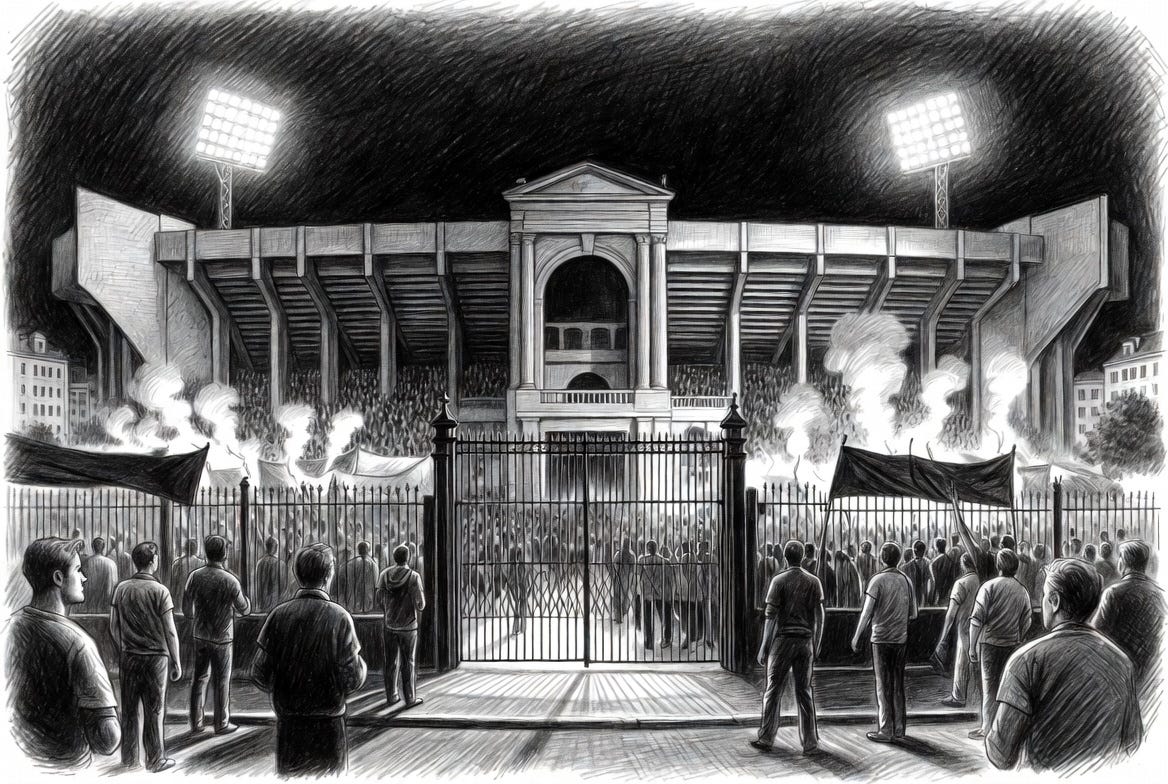
The backlash was volcanic. Fan protests erupted outside stadiums across England. Players and managers spoke publicly against it. Politicians threatened legislative intervention. Within 48 hours, nine of the twelve founding clubs had withdrawn. The project collapsed before a single match was played.
What did not collapse was the financial logic that created it. The clubs were responding to the same pressure driving American conference consolidation: when media money concentrates at the top of a sport, the entities generating the most value start asking why they are sharing it with everyone else. The European Super League failed because European fans still carry real weight, and European regulators are willing to step in when they don’t like what they see. American college sports has neither of those things in the same form. The consolidation has crept in gradually, one realignment wave at a time, and most fans have absorbed each move without quite noticing where it’s all headed.
Notre Dame’s Impossible Position
No program illustrates the stakes more clearly than Notre Dame.
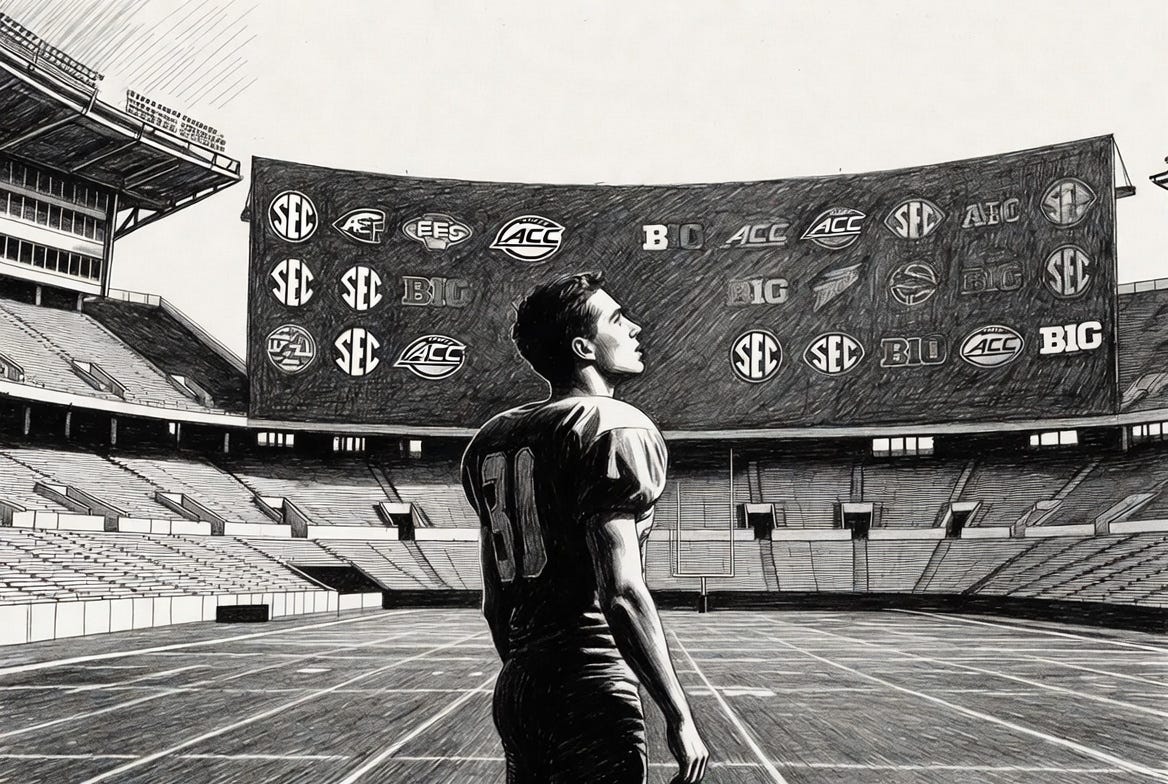
The Fighting Irish have maintained their football independence since 1991, built around a standalone deal with NBC that has been extended through 2029 and is estimated to be worth somewhere between $50 and $60 million annually. Notre Dame’s football identity is inseparable from that relationship — the school built its national brand around being the one major program that answers to no conference. While most of the sport reorganized itself around conference revenue pools, Notre Dame kept its own arrangement and made it work.
The College Football Playoff has been unusually good to Notre Dame. Under the terms of the new CFP contract running from 2026 through 2031, Notre Dame automatically qualifies for the 12-team field if it finishes ranked in the top 12 of the final CFP rankings, with no conference championship game required. For a program that plays no such game by definition, that is not a small thing. The Irish made the expanded playoff field in its first season, which validated the independence model in the short term and quieted some of the pressure to join a conference.
But Notre Dame is genuinely alone in that position now. Army and Navy, once fellow football independents, both play as football-only members of the American Athletic Conference — Army joined in 2024, Navy was already there. The remaining FBS independents are UConn and UMass, programs without Notre Dame’s brand leverage or realistic playoff aspirations. The Irish negotiated a place in the new college football order. Everyone else either joined a conference or accepted the margins.
The arrangement works as long as the broader system remains open enough to accommodate it. Notre Dame does not share in the conference revenue pools that ACC, Big Ten, and SEC members receive. The NBC deal is valuable, but it covers home games. If the SEC and Big Ten formalize their dominance into something closer to a closed structure — with tighter playoff access, separate revenue sharing, and potentially congressional antitrust protection — Notre Dame’s independence stops being a carefully managed advantage and becomes something considerably more precarious.
The 1984 ruling gave schools and conferences the right to control their own television destiny. Notre Dame used that right to build something genuinely singular. Now the conferences that used the same right to build something enormous are quietly discussing whether to change the rules of the game entirely. Notre Dame did not get a vote on that conversation. Neither did anyone outside the SEC and Big Ten.
Which brings everything back to a college basketball game that may or may not end up in a baseball stadium in Miami. The Duke-Michigan situation is a small story about contracts and territorial maps. But it is also a window into a much larger question about who decides how college sports works, who profits from those decisions, and whether the system that emerged from a 1984 courtroom is finally running out of room to grow.
Oklahoma and Georgia wanted more exposure, and they got it. What remains to be seen is what happens when the schools with the most exposure decide they’ve outgrown the system that gave it to them.
The Deeper Dive
The Sports Broadcasting Act of 1961 is short enough to read in ten minutes and specific enough to reward careful attention. Most sports fans know vaguely that the NFL has some kind of antitrust exemption. Fewer know exactly what the league gave up to get it.
The mechanics of the trade are worth laying out plainly, since the Main Story only sketched them. Two restrictions did the work: no NFL games on Friday nights after 6:00 p.m., and no NFL games on Saturdays within 75 miles of a high school or college game, for a window stretching from the second Friday in September through the second Saturday in December. Outside that window — including the entire postseason — the NFL faces no such limits. In 1961, with the college football season effectively over by mid-December, that carve-out cost the NFL almost nothing. The calendar did the protecting on its own.
What makes this worth understanding now is how cleanly the December cutoff aligns with the college football regular season calendar. The second Saturday in December is roughly when conference championship games wrap up and the college regular season effectively ends. After that point, the NFL is legally free to schedule Saturday games, and it does. The College Football Playoff then runs into January directly against NFL wild card and divisional weekends. The 1961 law protected college football’s regular season. It left the postseason exposed.
The ratings consequences are real and not subtle. College Football Playoff games airing in windows with direct NFL competition consistently draw lower numbers than comparable games without that competition. A first-round CFP game averaged 10.6 million viewers in 2024 — a strong number in isolation, but still well below what a comparable NFL game draws in the same window. The NFL does not need to be doing anything extraordinary to beat college football head to head. A middling regular season game between two average teams will usually outperform a meaningful college playoff game on the same afternoon.
This is the environment in which the SEC and Big Ten are contemplating collective negotiation. They are not just trying to maximize revenue from college sports fans. They are trying to build a rights package valuable enough that networks will pay a premium simply to secure access before a competitor does — the same dynamic that made the NFL’s model so powerful. The Sports Broadcasting Act made that possible for professional football in 1961. College sports would need its own version to attempt something similar today, and getting it through Congress would mean dealing with every mid-major conference, every smaller school, and every politician whose district has a program that would be left outside the new structure.
That political problem may ultimately be the biggest obstacle. The NFL had 32 teams and a relatively contained lobbying task when Rozelle went to Congress in 1961. The SEC and Big Ten would be asking Congress to grant a carve-out that explicitly advantages two conferences at the expense of everyone else in college sports — at institutions that receive federal funding, which gives Congress standing to push back. Getting that through a legislative body where every state has colleges and universities with a stake in the outcome would be a different kind of fight entirely.
For the Curious
The full text of NCAA v. Board of Regents of the University of Oklahoma is worth reading if you want to understand how the Court actually thought about college sports and antitrust law. Justice Stevens’ majority opinion is careful and surprisingly readable for a legal document of its era. The framing of the NCAA as exercising “almost absolute control” over supply, price, and output is striking language, and the dissent by Justices White and Rehnquist — who argued the NCAA’s arrangement deserved more deference as an amateur sports regulator — gives a useful sense of how divided the Court actually was. You can read the full opinion for free through the Cornell Law School Legal Information Institute.
On the European Super League, the documentary Super League: The War for Football walks through the 2021 attempt in detail, from its launch to its collapse. It is available on Apple TV+. Candid caveat: the film is largely sympathetic to the fan and club perspectives that opposed the breakaway, and critics of that framing argue it understates the genuine financial pressures the founding clubs were responding to. The more interesting question the documentary raises, without quite answering it, is whether the fan backlash actually solved anything or simply delayed a reckoning that the economics of elite soccer make inevitable.
Worth Watching
The College Football Playoff’s expansion keeps changing how programs approach their seasons. Keep an eye on which mid-major conferences push hardest for guaranteed access in the next round of CFP negotiations — that fight will tell you a lot about whether college football’s power structure is willing to share anything at all, or whether consolidation is already past the point of reversal.
Thanks for reading The Precedent. If you enjoyed this issue, share it with someone who would too.
Written by Bob Sloop