The Last Time Baseball Looked Like This, They Changed the Rules
Batting averages are at their lowest since 1968. History tells us what usually comes next.

We’ve Been Here Before
Pitching is dominating baseball again in 2026. History tells us what usually happens next, and this time, technology might be the answer.
If you’ve watched much baseball this season, you may have noticed something feels a little off at the plate. Hitters are struggling. Pitchers are dealing. Scoreboards look more like hockey scores from the 1950s than a modern era of offensive firepower. The league-wide batting average is hovering around .241, the lowest it’s been since 1968.
That’s not a coincidence. The number 1968 is worth paying attention to, because baseball has been exactly here before. What happened that year, and what the league did about it, might be a preview of what’s coming. Only this time, the fix might come from a computer rather than a rulebook.
The Year the Pitchers Took Over
To understand 1968, you have to understand Bob Gibson.
The St. Louis Cardinals right-hander was already one of the most intimidating figures in baseball when the 1968 season began. He was big, he threw a mean fastball, and he genuinely scared hitters. He owned the inside half of the plate and made no apologies for it. During that season, he hung a sign above his locker that read simply: “Here comes the judge.” (Not that Judge. Aaron Judge was still about 37 years away from making the name famous in the Bronx.)
He wasn’t wrong.
Gibson started 34 games in 1968 and went the full nine innings in 28 of them. He threw 13 shutouts. He had a stretch from June through July where he won 11 straight starts, all complete games, and gave up a grand total of three runs. His ERA for the entire season was 1.12. That number isn’t a typo. It remains the lowest single-season ERA in modern baseball history.
But Gibson wasn’t even the whole story. He was just the most spectacular example of a much bigger problem. Twenty-two pitchers across both leagues posted earned run averages below 2.00 that year. The Detroit Tigers’ Denny McLain won 31 games, a number that seems almost fictional by today’s standards. The Dodgers’ Don Drysdale threw 58 consecutive scoreless innings. Only six hitters in all of baseball batted over .300, combined across both leagues.
The league-wide ERA was 2.98. Fans were going to games and watching a whole lot of nothing happen at the plate.
“There is ample evidence,” wrote Washington Post columnist Bob Addie late that season, “that the public is getting a wee bit tired of all these pitchers’ duels.”
Baseball had a problem. And it decided to do something about it.
Baseball’s Answer: Change the Rules
After the 1968 season ended, MLB officials didn’t wait around. In December of that year, a rules panel voted to make two significant changes before a single pitch of the 1969 season was thrown.
First, they lowered the pitcher’s mound. The mound had been sitting at 15 inches above home plate. They dropped it to 10 inches, where it remains today. A higher mound gives pitchers a steeper downward angle on their pitches, making them harder to hit. Lowering it leveled the playing field, literally.
Second, they shrank the strike zone back to its traditional boundaries. Umpires had been calling a generous strike zone for years, one that tilted the advantage heavily toward pitchers. The league told umpires to enforce it more tightly.
The numbers in 1969 told a good story. Runs per game climbed from 3.42 to 4.07, and the league batting average rose eleven points from .237 to .248. Whether the mound change deserves full credit is debatable; 1969 also happened to be an expansion year, adding four new teams and diluting pitching depth across the league. But something worked, and baseball was happy to call it a success.
So Why Is Batting Average Down in 2026?
Here’s where the 2026 story gets more nuanced and more interesting than a simple repeat of 1968.
The long-term decline in batting average isn’t new. It’s been building for nearly two decades, pushed along by forces that have nothing to do with umpires. Average four-seam fastball velocity has climbed from 91.1 mph in 2008 to 94.2 mph today, meaning hitters have progressively less time to react to every pitch. Spin rate analytics gave pitching coaches the ability to fine-tune breaking balls with a precision Gibson and his contemporaries would never have believed possible. And the evolution of bullpen strategy means hitters rarely face the same pitcher twice in a game, eliminating any opportunity to adjust through repeated looks.
These aren’t things that changed in 2026. They’ve been grinding batting averages down for years.
What makes 2026 specifically interesting is what’s happening on top of those long-term trends. The new Automated Ball-Strike system (more on that in a moment) had an effect on umpire behavior that nobody saw coming. Knowing their calls would now be subject to challenge and review, umpires quietly began calling a tighter strike zone even before the first pitch of the season. Borderline strike calls on the edges of the plate dropped sharply. The zone that pitchers had quietly relied on for years got smaller overnight. Paradoxically, a system built to make ball-strike calls more consistent actually reduced the number of hittable pitches in the zone, sending walks up 7.3% and scrambling offensive rhythms in ways that are still sorting themselves out.
So 2026 isn’t 1968. It’s something new: a long-simmering problem colliding with an unexpected technological side effect. The result just happens to look eerily familiar.
Enter the Robot Umpires
The Automated Ball-Strike system, known as ABS, debuted in the major leagues this season after years of minor league testing. It works like this: umpires still call every pitch the old-fashioned way, but pitchers, catchers, and batters each have the ability to challenge a call by tapping their helmet. The challenge goes to a Hawk-Eye camera system that reviews the pitch location within seconds and either confirms or overturns the umpire’s call. Each team starts the game with two challenges and keeps them if successful.
The early results are striking. Through the first month of the season, the system upheld 53.4% of challenges, meaning nearly half of disputed calls were overturned. Pitch-framing, the art catchers have spent careers mastering to steal borderline strikes, has already declined significantly. The computer doesn’t get fooled by a smooth glove.
In-stadium, the reaction has been enthusiastic. Fans are cheering challenges the way they cheer replay reviews in football. “Outside!” becomes a moment. The energy is real.
But here’s the deeper irony: by making umpires accountable, ABS has actually tightened the strike zone before the computer even gets involved. Umpires are calling fewer borderline strikes on their own initiative, simply because they know a challenge might prove them wrong. The result: more walks, more pitches outside the zone, and hitters who are paradoxically less comfortable because the predictable edges of the zone they used to exploit have disappeared.
What Do Fans Actually Want?
Here’s where it gets genuinely interesting, and where opinion is more divided than you might expect.
MLB’s own Spring Training survey found that 69% of fans want to go to full ABS, meaning the computer calls each pitch with no challenges at all. That’s a strong majority. But a Seton Hall Sports Poll found something different: 45% of MLB fans don’t think baseball should adopt a system where the computer reviews every pitch automatically, versus only 31% who do. A brand-new survey found that 38% of Americans love the challenge system, 20% disagree, and 42% say they don’t know what to think yet.
Fan opinion is still forming. The challenge system is new enough that plenty of people haven’t decided what they want from it. The in-stadium energy suggests the drama of a challenge moment is popular. But whether fans want the computer to take over entirely is a genuinely open question.
Players, for their part, are divided. Many prefer the challenge system over full automation because it preserves pitch framing, a craft catchers have spent careers developing. When full ABS was tested in the minor leagues, players, coaches, and fans pushed back, citing more walks, longer games, and the elimination of that subtle art. The Players Association has not issued a unified position, though it supported the ABS rollout as negotiated under the collective bargaining agreement.
Commissioner Manfred specifically thanked the Major League Umpires for their collaboration in the ABS rollout.
Three Schools of Thought
So where does this leave baseball in 2026? There are really three positions worth understanding.
Leave it alone. Pitching dominance is a legitimate outcome of how the game has evolved. Today’s pitchers are the best-conditioned, most analytically optimized athletes in the sport’s history. Penalizing excellence to manufacture offense feels artificial. A 2-1 pitching duel has its own audience.
Use the tools already in place. ABS is already reshaping how the game is called. Give it time to work before reaching for bigger interventions. Umpires are recalibrating, hitters and pitchers are adapting, and the dust hasn’t settled yet.
Go further. If batting averages keep dropping, full automation becomes harder to resist: every pitch, no challenges, no human behind the plate. The technology exists. Interestingly, the umpires have largely collaborated on the ABS rollout rather than fighting it. The real resistance has come from players themselves, many of whom prefer the challenge system because it preserves pitch framing. Whether that player preference holds as the numbers keep trending downward is an open question.
History Doesn’t Repeat, But It Rhymes
The 1968 season didn’t spring up overnight. It took nearly a decade of pitchers gradually gaining the upper hand before the numbers got too big to overlook. The league watched. It monitored. And when it finally acted, it rewrote the rules.
The difference between 1968 and 2026 is that baseball today has tools its predecessors could never have imagined, and those tools are already changing the game in ways nobody fully anticipated. The question isn’t whether the technology can rebalance things. It’s whether baseball is willing to let it, and how far it’s prepared to go.
The pitchers keep getting better. The computers keep getting more accurate. Something has to give.
Bob Gibson would probably hate whatever they come up with. But even he’d have to admit it: runs went up, batting averages climbed, and the game moved on. Whether it was the mound, the zone, the expansion teams, or all three, baseball declared victory and never looked back.
Worth Watching
Keep an eye on the Tampa Bay Rays, who are quietly sitting near the top of the American League standings under new ownership despite one of the lowest payrolls in baseball. It’s early, but if they sustain it, their front office approach of building through analytics, development, and smart roster construction will be one of the best stories in baseball this summer.
The Deeper Dive: The Man Behind the Myth
The numbers tell you Bob Gibson was dominant. What they don’t tell you is what it was actually like to face him.
Dusty Baker, who spent 19 years in the major leagues and managed for another 26, said something that captures it better than any ERA ever could: “The only people I ever felt intimidated by in my whole life were Bob Gibson and my Daddy.”
Baker wasn’t alone. Hank Aaron, a man who faced the best pitchers of two generations without flinching, pulled Baker aside early in his career and gave him a set of instructions so specific they sound more like a survival guide than baseball advice. Don’t dig in against Gibson. He’ll knock you down. Don’t stare at him. Don’t smile at him. Don’t talk to him. If he hits you, don’t charge the mound, he was a Golden Gloves boxer. If you hit a home run, don’t run too slow and don’t run too fast. If you want to celebrate, get in the tunnel first.
That was the operating manual for facing Bob Gibson.
What makes him fascinating as a character, not just as a pitcher, is that he was largely unaware of the effect he had. In a 2010 Newsweek interview, Gibson reflected on his reputation with something close to genuine surprise: “The intimidation thing didn’t come from me. It was in the eye of the beholder. People built up all of this stuff, and they came up with this ogre-type image. After I retired and got older and heard all these stories, I was like — damn, I didn’t know they felt like that. I wish I had known. Because if I had known I intimidated people the way I did, I would’ve been even uglier.”
His teammate Joe Torre put it more bluntly: “Bob wasn’t just unfriendly when he pitched. I’d say it was more like hateful.”
Gibson’s own explanation was simpler. “My thing was winning,” he wrote in his autobiography. “I didn’t see how being pleasant or amiable had anything to do with winning, so I wasn’t pleasant on the mound and I wasn’t amiable off it.”
He worked fast, almost aggressively so, which hitters interpreted as a psychological tactic. Gibson always insisted it was just his personality. But when hitters kept stepping out of the box to slow him down, it genuinely irritated him, which only made him more imposing. The intimidation fed on itself.
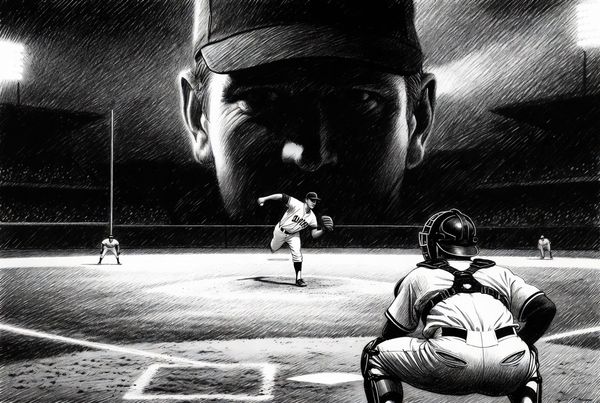
His delivery added to the effect. After releasing the ball, the right side of his body hurtled violently toward the first base line, giving hitters the impression that he was physically exploding in their direction. His cap pulled low. His eyes fixed on the catcher’s mitt, or so hitters thought. Gibson was actually nearsighted and couldn’t see them clearly. The famous glare was essentially a visual aid.
What the mythology sometimes obscures is the craft underneath it. Gibson didn’t beat hitters with fear alone. He had pinpoint control of two different fastballs and a vicious slider. He set hitters up with inside heat and finished them on the outside corner. He was a student of the game who thought deeply about how to get each hitter out.
The legend of Bob Gibson the intimidator is real. But Bob Gibson the pitcher was something even more dangerous: a man who combined that presence with genuine, relentless excellence. The 1968 season was the intersection of both at their absolute peak.
For the Curious
Two recommendations this issue, one for the big picture and one for the close-up.
Year of the Pitcher: Bob Gibson, Denny McLain, and the End of Baseball’s Golden Age by Sridhar Pappu (2017)
Pappu uses the 1968 season as a lens to examine two men who could not have been more different. Gibson was disciplined and fearsome; McLain was a brash self-promoter who flew his own plane while his teammates took the team charter. One black, one white. One serious, one reckless. Both historic. The book places the season in the context of a turbulent America, with King, Kennedy, and Chicago all playing out in the background, while keeping baseball at the center. The Boston Globe called it seldom matched for vividly bringing an era and its personalities to life. Worth knowing going in: some readers feel the historical context enriches the story, others feel it occasionally overshadows the baseball. Judge for yourself.
Pitch by Pitch: My View of One Unforgettable Game by Bob Gibson with Lonnie Wheeler (2015)
If the Pappu book is the wide-angle lens, this is the extreme close-up. Gibson walks through one complete 1968 World Series game, pitch by pitch in his own voice, explaining exactly what he was thinking, why he threw what he threw, and what was going through his head at every moment. No agenda, no outside interpretation. Just one of the greatest pitchers who ever lived taking you inside his mind during the best season of his career. For anyone who wants to understand what elite pitching actually feels like from the inside, this is as close as you’ll ever get.
The Precedent is a biweekly newsletter covering sports through a deeper lens — strategy, history, and everything behind the game. Written by Bob Sloop. If someone forwarded this to you and you’d like to subscribe, visit theprecedentmedia.com
Follow us on X at @PrecedentMedia
Written by