

Patrick Mahomes threw for 3,587 yards last season, but even he admitted the offense hadn’t been consistent enough. As is his style, Mahomes put the blame directly on himself. That’s part of what made him the best quarterback of his generation, and some argue the best of all time. It’s also a symptom of a problem the Chiefs spent this entire offseason trying to fix so he wouldn’t have to keep saying it.
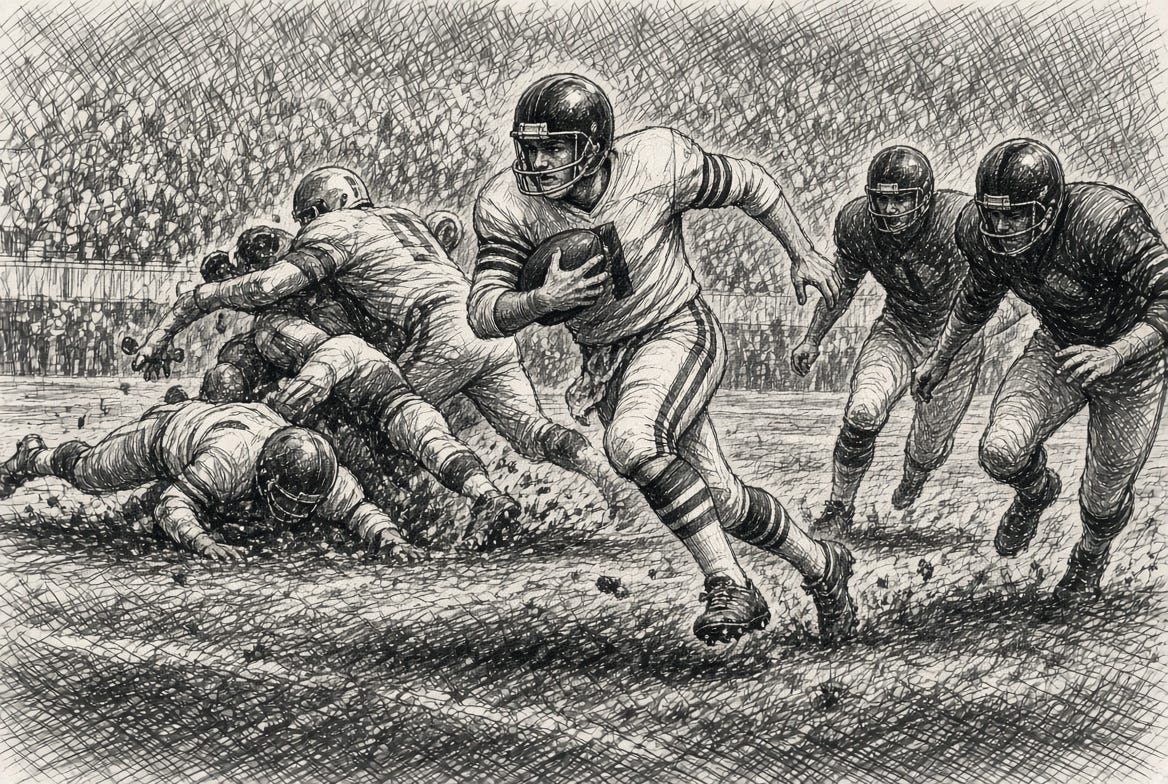
The offense wasn’t broken in 2025, but Chiefs fans might disagree. An offense that used to not sweat at all on 3rd-and-18 made fans nervous on 2nd-and-2. It ranked 11th in the league in overall efficiency, respectable by most standards, underwhelming by the standard Kansas City set for itself. The real trouble showed up in the specific moments that used to define this team. Third down, where the Chiefs had built a decade of reputation manufacturing conversions out of nothing, dropped to 22nd in the league. At one stretch early in the season they were converting barely a third of their third downs. The running game produced exactly one run over 20 yards from an actual running back all year. Nearly every other explosive rushing play came from Mahomes scrambling for his life, which is not something you want to lean on with a 30-year-old quarterback returning from a torn ACL.
The Diagnosis
Mahomes himself said that defenses had seen a lot of the plays Kansas City had leaned on for years, and the offense needed new answers. That’s not a decline story. The league always catches up. Coordinators had years of tape on Kansas City’s go-to concepts, and those concepts stopped working as often. Add an offensive line that cycled through 17 different combinations over the season, with the Week 1 starting five playing together for exactly two games after Week 6, and you get an offense leaning harder every week on one player to bail it out.
The injuries tell the story in specifics. Left tackle Josh Simmons needed wrist surgery and landed on injured reserve. Right tackle Jawaan Taylor missed time. Right guard Trey Smith went down late in the year. By Week 14, Kansas City was projected to start two backup tackles, Wanya Morris and Jaylon Moore, alongside a backup guard just to field a line. The pressure showed up before Mahomes ever got hurt. From Week 8 on, he was sacked at least three times in every single game, and on Thanksgiving against Dallas, that number hit four.
The numbers back up what Mahomes was describing. Early in the season, Kansas City actually ranked second in the league in rushing plays of 10 yards or more. That sounds like progress until you look at where those runs came from. Seven of the team’s nine explosive rushing plays came off Mahomes scrambles, not handoffs. The ground game wasn’t creating explosive plays. Mahomes was creating them himself, with his legs, on broken plays, which is a great highlight reel and a terrible long-term plan for a quarterback who’d just torn his ACL.
Brett Veach put it in blunt front-office terms this spring. He wanted the running game to be more explosive because a real ground threat takes pressure off everybody, especially a quarterback working his way back from a major injury. That’s the entire thesis of Kansas City’s 2026 offseason, stated by the man who built it.
The Fix
The headline move was signing running back Kenneth Walker III in March. A team that had relied on late-round draft picks and older running backs for several years was finally admitting they couldn’t do that any longer. An even more revealing decision came in where the resources went after that. Veach specifically singled out the interior offensive line trio of Kingsley Suamataia, Creed Humphrey and Trey Smith, saying the plan was to take advantage of those three to impose your will on an opposing defense. Impose your will is not the language of a team that built a dynasty on spacing and matchup problems. It’s the language of a team trying to become harder to solve, not just faster.
Eric Bieniemy’s return as offensive coordinator reads the same way. Bieniemy coached Kansas City’s running backs from 2013 through 2017 before ever calling plays, then ran the offense as coordinator from 2018 through 2022, helping the Chiefs win their first two Super Bowl titles of the Mahomes era. Bringing him back isn’t just a reunion. It’s a bet that the coach who built the running back room the first time around is the right person to rebuild it now, at exactly the moment the Chiefs need it most. Since coming back, his message has been almost stubbornly basic. Do the fundamentals right or nothing else matters, he said. That’s a push toward an offense that doesn’t need a magic trick on every third down just to move the chains.
They didn’t stop at one running back either. Fifth-round pick Emmett Johnson joined the room alongside Walker, Emari Demercado and Brashard Smith, which says Kansas City wanted real competition at a position that had neither depth nor juice last season, and perhaps a nod to the fact that Walker shared carries in Seattle prior to Zach Charbonnet getting injured in the playoffs.
Johnson wasn’t the only rookie brought in to fill a specific gap. Kansas City used its first two picks after Delane on defense, taking defensive tackle Peter Woods and edge rusher R Mason Thomas, then circled back for cornerback Jadon Canady in the fourth round and wide receiver Cyrus Allen in the fifth. Even the sixth-round pick, quarterback Garrett Nussmeier, reads less like a lottery ticket and more like organizational patience, developmental depth behind Mahomes rather than a threat to his job. Look at the class as a whole and a pattern emerges. Kansas City didn’t spend this draft chasing one big fix. It spent the class reinforcing almost every position tied to the thesis: protect Mahomes, support the run game, and make the defense finish what it starts.
The Other Half
The Chiefs acknowledged that the run game wasn’t the entire problem. Kansas City’s defense generated pressure on more than half its third-and-long snaps last season and turned almost none of it into sacks, finishing with the seventh-fewest sacks in the league while allowing opponents to convert 44 percent of their third downs. A defense that creates pressure but can’t finish plays puts the offense right back where it started, needing to be perfect. So the Chiefs spent real capital there too. Defensive tackle Peter Woods and edge rusher R Mason Thomas came off the board with their first two picks after cornerback Mansoor Delane, and run-stopping tackle Khyiris Tonga arrived in free agency. They also brought back cornerback L’Jarius Sneed, a two-time champion in Kansas City who already knows what Steve Spagnuolo wants from his defensive backs.
The Chiefs are betting on the problem having been the talent, not the coaching schemes. Spagnuolo is still calling the same aggressive, pressure-first defense he’s always called. What changed is the talent underneath it, built specifically to finish what the pressure package starts.
Put the two halves together and the picture sharpens. Kansas City isn’t trying to make Mahomes less important. They’re trying to make him less necessary on every single snap, so the next time the league takes something away, as it just did, there’s enough around him to absorb it instead of asking him to make up the difference by himself.
The Deeper Dive
Teams that consistently win eventually run into the same issues. The league adjusts, the quarterback ages another year, and whatever edge used to separate them from everyone else gets thinner. Every dynasty comes to an end. What the front office builds around the quarterback determines how long the window stays open.
The 1990s Cowboys are worth revisiting here, though not for the reason people usually bring them up. Troy Aikman never had to become a different quarterback to win three Super Bowls in four seasons. He wasn’t the reason for all of their success the way Mahomes and the other all-time greats have been in their runs. Emmitt Smith won four rushing titles in that stretch, Michael Irvin gave Aikman a real outside threat, and the offensive line in front of them was arguably the best of its era. When Jimmy Johnson left after the 1993 season and Barry Switzer took over, the formula didn’t change. Dallas kept feeding Smith, kept protecting Aikman, and kept reinvesting in the trenches, drafting guard Larry Allen in 1994 to reinforce a line that was already the engine of the whole operation.
The defense is where Dallas made its most telling move. After losing the 1994 NFC Championship to San Francisco, the Cowboys signed Deion Sanders that September, adding a true difference-maker to a unit that already had Charles Haley and Darren Woodson. Aikman didn’t need to throw for 4,500 yards to win the 1995 Super Bowl. He needed a complete enough team around him that he didn’t have to.
San Francisco’s response to that same Dallas problem tells the flip side. After back-to-back conference championship losses to the Cowboys, the 49ers didn’t ask Steve Young to simply outduel Aikman. They rebuilt the defense that had been the actual gap, adding six new starters in 1994 alone, Sanders among them a year before he landed in Dallas, plus linebacker Ken Norton Jr. San Francisco went 13-3, Young won MVP, and the 49ers finally got past Dallas in the title game before winning the Super Bowl.
Both franchises landed on the same answer from different directions. An elite quarterback buys a lot, but not forever, and not alone. The help usually shows up in the trenches and on defense, not in asking the quarterback to be more spectacular than he already is. Kansas City’s 2026 approach, an interior line built to impose its will and a defensive front retooled to finish what it starts, reads like a team that studied the same history we just did.
For the Curious
If you want the fuller, rougher version of how that Cowboys roster actually came together, Jeff Pearlman’s Boys Will Be Boys: The Glory Days and Party Nights of the Dallas Cowboys Dynasty is worth your time. It’s a candid, sometimes uncomfortable look at what that locker room was really like off the field, and it doesn’t clean up the parts of the story that don’t reflect well on the people involved. Worth knowing going in if you’d rather keep this one strictly about football.
Worth Watching
Keep an eye on Kansas City’s first five regular season games. That stretch should answer the real question hanging over this offseason: is the offensive output we’ve come to expect from this team back, or is something more structural going on that a new running back and a healthier line can’t fully fix.
Thanks for reading The Precedent. If you enjoyed this issue, share it with someone who would too.
Written by Bob Sloop.