
Two Football Games
Arch Manning, the weight of a name, and what patience still buys in college football

A quick note before we get into it: starting with this issue, every edition of The Precedent will have a companion video. It’s called Beyond The Precedent, and it’s where I actually give you my take — my real opinion on the story, not just a recap of what you just read. The first episode goes live on YouTube this Thursday, September 10th, at 6 PM Central, just a few hours after this issue lands in your inbox. You can find and subscribe to the channel here. Now, onto Arch Manning.
In January of 2025, sitting in front of reporters with a Heisman conversation already swirling around him, Arch Manning said something that cut through most of the noise. He had received, he admitted, a lot of undeserved attention because of his last name. Then he added the line that mattered more. He hadn’t done anything yet. He had started two football games.
It was a strange thing to hear from the most hyped quarterback prospect of his generation, a kid who’d been compared to his uncles since middle school and treated as college football’s biggest story before he’d thrown a single meaningful pass. But it was also true, and it framed the question Texas was about to answer in real time. Was Arch Manning going to be good because he was patient, or was he simply given more patience than anyone else because of who he was?
A Redshirt With Real Reps
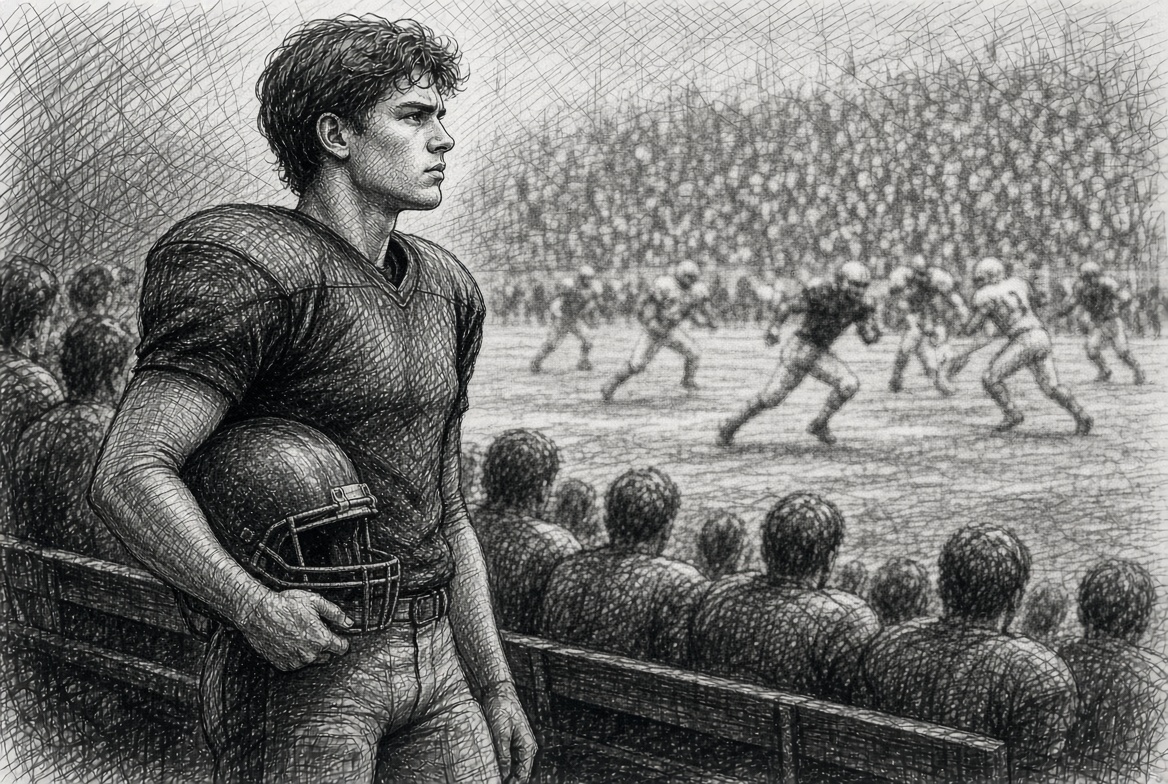
The popular shorthand is that Manning spent two years on the bench behind Quinn Ewers before finally getting his shot. That’s not quite right, and the details matter. In 2023 he redshirted, appearing in just two games under the rule that lets a player see limited action without losing the season, two of five passing for 30 yards against Texas Tech and a mop-up snap in the Big 12 Championship Game. But 2024 was different. When backup Maalik Murphy transferred, Manning became QB2 for real and saw action in ten games, completing 67.8 percent of his passes. When Ewers went down with an oblique injury against UTSA, Manning came off the bench and threw four touchdown passes in relief. He started twice that season while Ewers was hurt.
Ohio State, Florida, and the Pile-On
Whatever goodwill the apprenticeship built evaporated fast once Manning actually had to carry a team by himself. Texas opened its 2025 season ranked No. 1 in the country, with Manning as the new face of the program, and it lasted about three games before the doubts came roaring back. He completed just 55.3 percent of his passes across his first three starts, throwing three interceptions in the process. The Florida loss in early October was the low point. Sixteen of 29 for 263 yards sounds fine on paper, but two more interceptions and six sacks told the real story. Texas dropped to 3-2, and the same critics who’d questioned him as a recruit were suddenly back with fresh ammunition.
Ryan Clark said flatly that Manning wasn’t a generational talent. Johnny Manziel piled on about his high school competition, joking that the players chasing him on tape at Isidore Newman looked like they were barely moving. It wasn’t a new argument. Recruiting analyst Mike Farrell had made a version of it back in 2022, saying that if Manning’s name were Arch Smith, he’d have been rated a three-star prospect instead of the top overall recruit in the country. Isidore Newman plays in Louisiana’s 2A classification, nowhere near the level of the state’s true football factories. The skepticism wasn’t limited to media personalities, either. Heading into 2026, a CBS Sports survey of anonymous NFL scouts and personnel executives named Manning among the most overrated players in the sport, right alongside Oklahoma State’s Drew Mestemaker. That’s a factual gap in his résumé, not just an opinion, and it gave the skeptics a real foothold once his college struggles started piling up.
The Turnaround Nobody Fully Trusts
Then something shifted. Over his final eight games, Manning completed 62.1 percent of his passes and threw just two interceptions, a dramatic reversal from his rocky start. He threw for 346 yards and three scores in an overtime win at Mississippi State, then followed it with a clean, mistake-free 328-yard, three-touchdown performance against a ranked Vanderbilt team. He capped the season with a Citrus Bowl MVP award against Michigan, racking up 221 passing yards, 155 rushing yards and four total touchdowns.
It wasn’t a perfectly clean arc. He still had a rough day at Kentucky and an ugly loss at Georgia mixed into that stretch. But the broader shape of the season was unmistakable: a quarterback who looked overwhelmed in September and looked like one of the best players in the country by December.
Would Arch Smith Have Gotten This Long
Here’s where the argument really lives. Steve Spurrier, never one to hold back, asked publicly why Texas let Ewers play over Manning for as long as it did if Manning was already this good, pointing out that Ewers only ended up a seventh round pick. It’s a punchy line, and it’s not entirely fair. Ewers had led Texas to a Big 12 title and back-to-back playoff berths, and threw for over 3,400 yards with 31 touchdowns in his final season. That’s not a guy who was just keeping a seat warm.
Cam Newton offered the sharpest defense of the whole arrangement, and it came from personal experience. Newton spent two years behind Tim Tebow at Florida before transferring to Auburn and winning a national title and the Heisman the following year. He said the point was never whether you’re starting, it’s whether you’re being developed, and he argued that Manning would have been foolish not to learn from watching Ewers manage a locker room and handle pressure up close.
Texas has actually run this experiment before, and it didn’t go nearly as smoothly. Chris Simms, son of Super Bowl-winning quarterback Phil Simms, arrived in Austin in the late 1990s under similar circumstances, a famous last name, sky-high expectations, and coach Mack Brown never quite settled on how to handle him. Simms and Major Applewhite bounced the job back and forth for years, a mess that likely cost Texas a shot at bigger things. Sarkisian’s disciplined patience with Manning looks less like an inability to say no to a Manning and more like a coach who watched his own program botch this exact situation once already and was determined not to repeat it.
Still, nobody can prove the counterfactual. Sarkisian has said publicly there was no extra pressure attached to Manning’s recruitment because of his name. He’s also said he saved a text from Cooper Manning sent right after Arch committed in 2022, one telling Sarkisian to make sure every recruit coming through the program knew Arch loved Texas and hadn’t taken money to commit there. It was a message about the decision itself, not a claim that Arch would play for free once he got there. He hasn’t. His NIL earnings are now among the highest in all of college sports. But the text still signals something: a father wanting it on record that the commitment wasn’t purchased, even if everything that followed it eventually was. Whether a quarterback with identical tape and an identical rocky freshman handoff would have received the same two years, absent the name, remains unknowable. That tension doesn’t resolve. It’s part of what makes the story worth telling.
Stafford, Nix, and the Others
History offers company on both sides of this. Matthew Stafford threw 13 interceptions as a true freshman at Georgia, a worse start statistically than Manning’s, and needed three full years before becoming the No. 1 pick in the draft. That’s the clean version of patience paying off. Bo Nix’s path was messier. He started immediately at Auburn, spent three years there without ever truly breaking out, and only became a Heisman finalist after transferring to Oregon. DJ Uiagalelei and Max Browne are the harder lessons. Both arrived as the most hyped quarterback recruits of their classes, both got real chances, and neither one turned into the player the hype promised, no matter how much runway they were given.
The lesson from all four isn’t that patience works or that it doesn’t. It’s that a rough freshman or sophomore season predicts almost nothing on its own.
What makes Manning’s situation increasingly rare is simply that he got the chance to find out. Look at the quarterbacks recruited just two classes ahead of him: among the top ten quarterback recruits in the 2021 class, eight of ten have already transferred schools. Staying in one place long enough to complete a real developmental arc, redshirt year, backup year, adversity, recovery, has become the exception rather than the rule in the current sport. Whether that exception was earned or handed to him is still an open question heading into 2026. Texas opens the season on September 5th, and for the first time, Manning gets to answer it with a full season of tape instead of two starts and a promise.
The Deeper Dive
The transfer numbers deserve one more layer, because they explain why the Manning situation feels increasingly like a relic rather than a blueprint. Go back to 2002, when Vince Young topped the recruiting rankings, and nearly every blue-chip quarterback from that class finished their careers at the school that originally signed them. Part of that was culture, but part of it was simply mechanics: transferring was much harder then, with real penalties attached. They didn’t just wait their turn out of loyalty. They waited because leaving came at a real cost.
That patience used to come with a real cost, though a smaller one than people assume. A one-time transfer used to cost a player a year, not a season. Under the old “five years to play four seasons” rule, sitting out after a transfer worked exactly like a redshirt, it burned a year off the clock without touching any of a player’s four seasons of actual competition. Nobody lost eligibility outright. But the year away was real, and it left less room for error, an injury or an earlier redshirt could still cause a player to run out of time before using every season they were owed. Today, none of that applies. A player can transfer as many times as they want and compete immediately, no clock penalty, no redshirt tax, no lost year at all.
That’s what makes the Manning experiment genuinely interesting rather than just another quarterback story. Texas had a rare set of circumstances that allowed it to run the old model: a stable, respected starter in Ewers who bought time without controversy, and a fanbase willing, if barely, to tolerate patience because of the name attached to the alternative. Strip away either of those pieces and it’s easy to imagine Manning transferring somewhere for a fresh start after a rocky 2025, the same path Bo Nix eventually took, rather than sticking around to author his own turnaround.
Whether that makes Texas smart or simply lucky is worth sitting with. Programs love to talk about player development as if it’s a repeatable formula. Manning’s case suggests it might be less about formula and more about circumstance, the right roster situation existing at the right moment for a program that could afford to wait, and the right player content to wait alongside it. Take away Manning’s own patience, and a talented, frustrated quarterback with his options and his name recognition could have gone anywhere he wanted.
For the Curious
If you want to go deeper on how patience and pressure shape young quarterbacks, ESPN’s 30 for 30 documentary “Elway to Marino” is worth your time. It covers the 1983 draft class, a group of quarterbacks who entered the league under wildly different circumstances and expectations, and it’s a good reminder that the tension between hype and readiness isn’t new, it just moves faster now than it did 40 years ago.
Worth Watching
Keep an eye on Texas hosting Ohio State on September 12th. It’s Manning’s first true measuring-stick game of the season, a rematch against the same team that beat him in his rockiest outing a year ago, and it’ll tell us fast whether last year’s turnaround carries over or whether the questions start all over again.
That's the research. For my own take on this story, watch Beyond The Precedent.
Thanks for reading The Precedent. If you enjoyed this issue, share it with someone who would too.
Written by Bob Sloop.
Written by